In the wake of the Seven Years War, the 1760s witnessed a vast and powerful British Empire that had incurred great expense to defeat France and her allies. At the same time, the number of colonists in the "new world" increased, pushing ever westward.
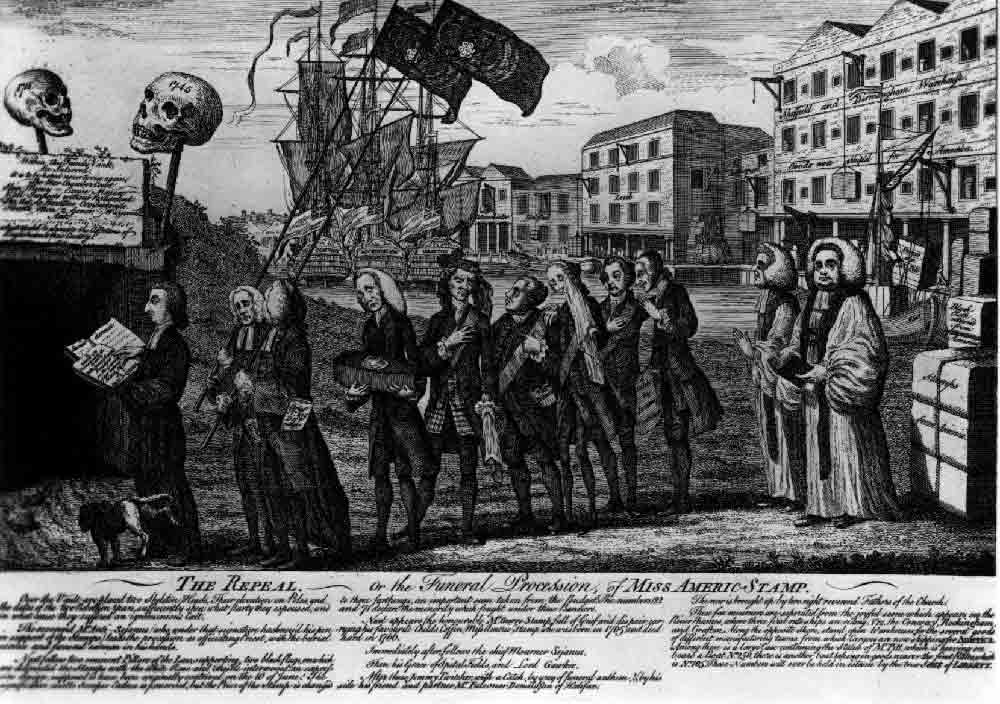
Engraving of the Repeal of the Stamp Act Titled "The Repeal or the Funeral Procession of Miss America-Stamp"
Courtesy Dr. Gary Milan Collection
In order to raise revenue to pay for the costs of the Seven Years War, Parliament past a tax called "The Stamp Tax", which required that a duty be paid and stamp affixed on a variety of legal documents. Angered by this tax and the apparent threat it posed to colonial autonomy, the colonists responded with pamphlets, protests and, occasionally, violence. While Parliament sought repayment for the costs of defending the colonies, the colonists feared that the British government would abuse them and erode their long-standing self-governance. Recognizing an opportunity for much needed revenue, Parliament imposed on the colonists new taxes for sugar, tea, paper, and other products. Each time the colonists opposed the taxes, and in response, Parliament repealed the taxes but passed new ones.
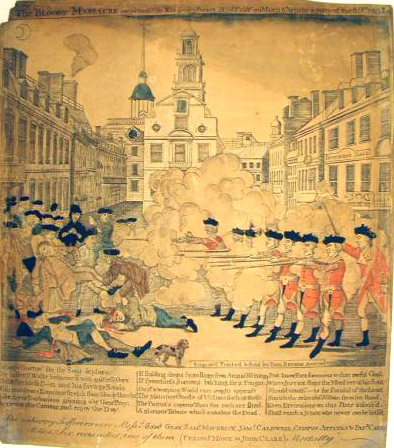
Hand Colored Engraving of the Boston Massacre
Courtesy Dr. Gary Milan Collection
As unrest continued, confrontation between colonist mobs and British troops took place. On the night of March 5, 1770, a mob of colonists in Boston pelted British guards with rocks and snowballs. The British troops panicked and fired on the colonists. Five members of the mob of citizens died in the incident, which was memorialized by noted silversmith and Son of Liberty Paul Revere in a famous engraving. He engraved and sold this depiction of the so-called "Boston Massacre" to gain support for the opposition to the British government.
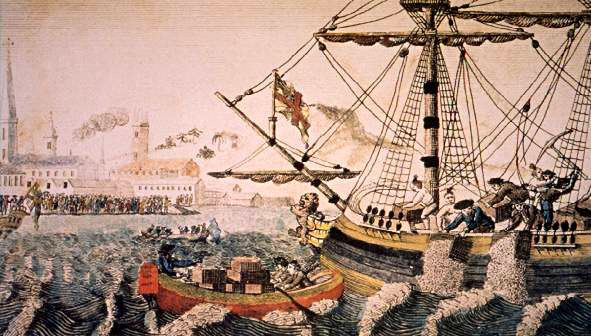
The Boston Tea Party
Engraving. Plate opposite by W.D. Cooper
On the evening of December 16, 1773, with crowds of people looking on, 150 Sons of Liberty dramatically boarded the ships, broke tea chests, and heaved them into the harbor. As news of the Boston "tea party" spread, other seaports followed the example and staged similar acts of resistance.
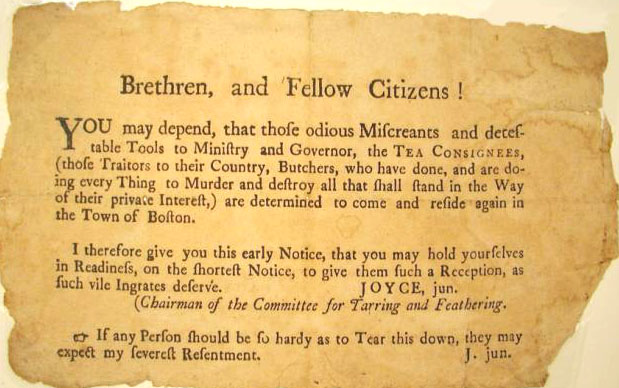
An Original Broadside "Invitation" to the Boston Tea Party
Courtesy Dr. Gary Milan Collection
The Declaration of Independence
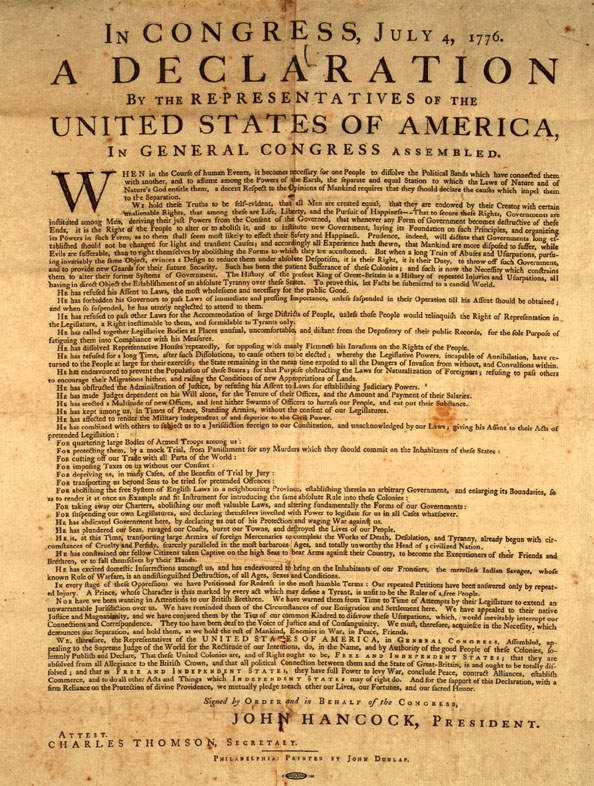
Courtesy Dr. Gary Milan Collection
British troops soon flowed into the colonies under the command of Sir William Howe. While 1776 saw the adoption of the Declaration of Independence for the Americans, the British enjoyed success on the battlefield, taking New York City and parts of the middle colonies. In the winter of that year, the Americans managed to keep their cause alive with success at Trenton against a British Hessian forces. The war continued to rage in the middle colonies of New York, New Jersey and Pennsylvania. The British captured the American capital of Philadelphia, but American forces under Horatio Gates smashed a British force at Saratoga in northern New York in 1777. During this period the American forces, especially those in the Continental Army, gained training and experience to acquit themselvesforcefully on the battlefield. In 1778, the French officially joined the war as allies of the Americans, hoping to avenge their earlier loss in the Seven Years War. In late 1778 the British moved their attacks southward with attacks on Georgia and, later, South Carolina. Forces under General Charles Cornwallis began to move northward with a series of victories culminating in a rout of American forces at Camden. In early 1781, however, American forces under Daniel Morgan defeated the British at Cowpens, and American forces under Nathaniel Greene battled the British to a draw at Guilford Courthouse in the midst of fierce hand-to-hand fighting. Cornwallis continued northward with his forces until he encamped on the peninsula of Yorktown in the colony of Virginia. There, American forces under George Washington combined with French infantry and navy forces to trap Cornwallis and force him to surrender his army. The British gave up major operations in the colonies thereafter, instead concentrating in other theaters, such as the West Indies. In 1783, the Treaty of Paris ended the war, with the Americans having gained their independence.